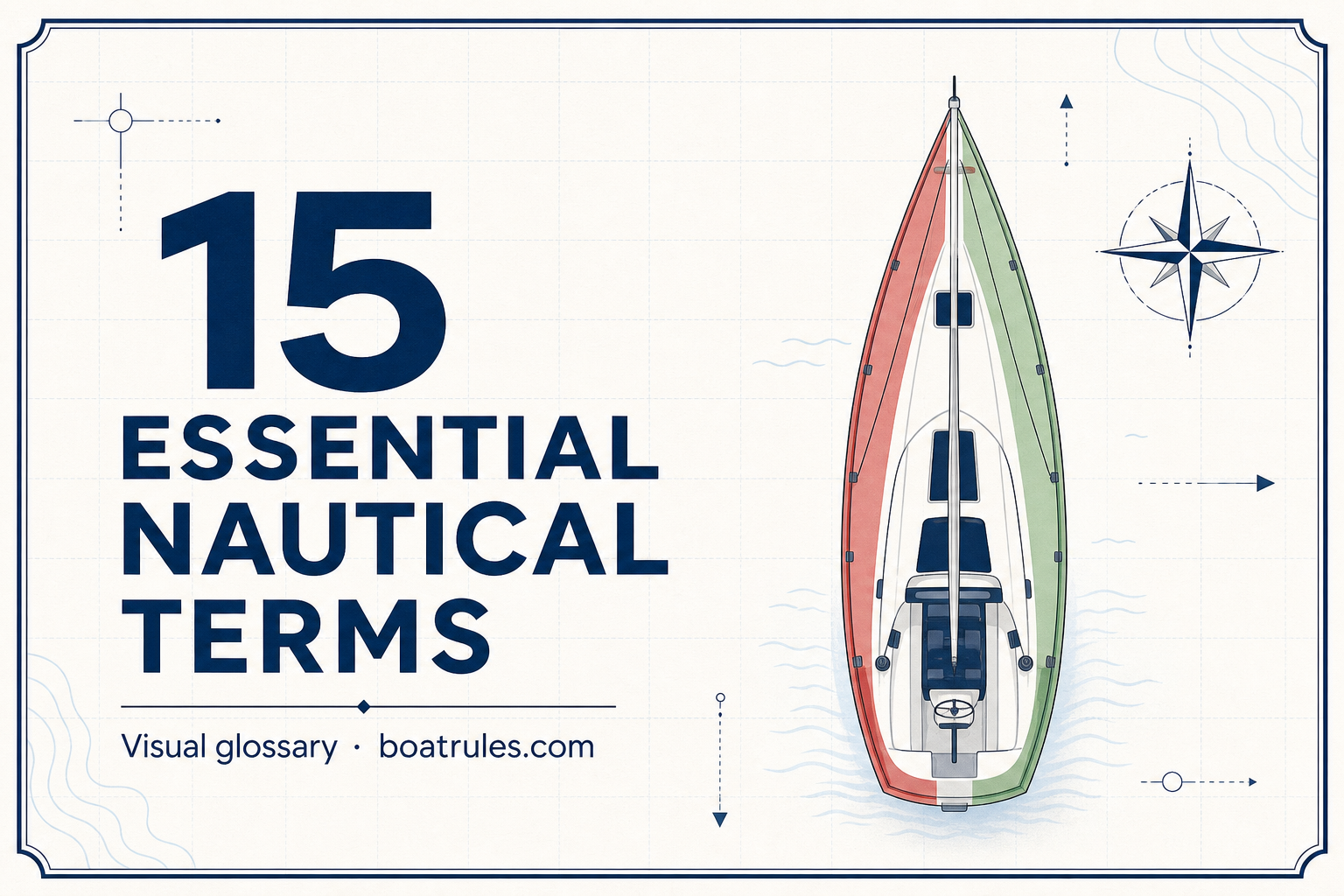
Visual seamanship
Boating & sailing glossary
Essential nautical concepts, explained with clear diagrams, practical examples, common mistakes, and links into the rules.
Explore the essentials
Choose a concept for the direct answer, visual explanation, practical use, and trusted sources.
Boat orientation
Fixed parts, sides, and relative directions.
Port
Port is the fixed left-hand side of a boat when you face forward toward the bow; its sidelight is red.
Starboard
Starboard is the fixed right-hand side of a boat when you face forward toward the bow; its sidelight is green.
Bow
The bow is the forward-most part or end of a boat, opposite the stern.
Stern
The stern is the after or rear end of a boat, opposite the bow.
Beam and abeam
Beam is a boat’s greatest width; abeam means approximately 90° to either side of its fore-and-aft line.
Helm
The helm is a boat’s steering gear—wheel or tiller—and, by extension, the person steering it.
Keel
The keel is the boat’s centreline backbone; on sailboats it becomes a ballasted fin that resists leeway and sets the deepest draft.
Movement and state
How a vessel is positioned and moving.
Ahead and astern
Ahead is the direction beyond the bow; astern is the direction beyond the stern or backward motion.
Underway vs making way
Underway is a legal status; making way means actually moving through the surrounding water.
Heel and trim
Heel is a boat’s sideways lean; trim is her fore-and-aft attitude—and, as a verb, the act of adjusting sails or balance.
Rules language
The roles used in collision-avoidance encounters.
Sailing and wind
Wind-relative sides and sail maneuvers.
Windward
Windward means toward the wind or on the side from which the wind is coming.
Leeward
Leeward is the side or direction away from the wind—the downwind side, opposite windward.
Tack
A boat’s tack is named for the side the wind comes from; to tack is to turn the bow through the wind.
Gybe (jibe)
A gybe is a sailing maneuver in which the stern passes through the wind and the sails fill on the opposite side.
Anchoring
Ground tackle and how much line the anchor needs.
Radio and distress
The call priorities every VHF user must know.
Share the visual essentials
Open a classroom-ready visual sheet, then print it or save it as a PDF.